

A promising business expansion or community development project can have everything it needs to succeed—a clear purpose, strong demand, and the potential to create jobs—yet still face a significant obstacle: access to affordable financing.
For manufacturers looking to expand, healthcare providers building new facilities, or community leaders investing in essential community services, traditional financing may not cover a project’s full cost. This challenge can be especially evident in rural or economically distressed communities, where access to private investment is often limited.
That’s where New Markets Tax Credits (NMTCs) can make a difference.
The federal NMTC program helps attract private capital to underinvested communities, giving qualifying businesses and community projects access to flexible financing. Understanding how the program works can help project sponsors, small business owners, and community organizations identify financing opportunities that might otherwise be out of reach.
Exploring NMTC financing? Advantage Capital’s Tax Credit Consulting team helps eligible organizations access NMTCs through project financing, application consulting, and strategic support. Get in touch with our team here to see if your project qualifies.
What Is the New Markets Tax Credit Program?
The NMTC program is a federal tax incentive established in 2000 to encourage private investment in economically distressed communities.
Administered by the U.S. Department of the Treasury’s Community Development Financial Institutions (CDFI) Fund, the program awards tax credit allocation authority to certified Community Development Entities (CDEs), which use the authority to attract private investment and finance qualifying businesses and community development projects.
In exchange for making qualifying investments, investors receive a federal income tax credit equal to 39% of their qualified equity investment, claimed over seven years.
The program helps make financing available for projects that may face challenges finding enough capital through typical sources.
Federal legislation enacted in 2025 made the NMTC program permanent, providing $5 billion in annual allocation authority and greater long-term certainty for investors, CDEs, and project sponsors.
How Do New Markets Tax Credits Work?
NMTCs connect private investors with businesses and projects in qualifying low-income communities through financial intermediaries known as CDEs.
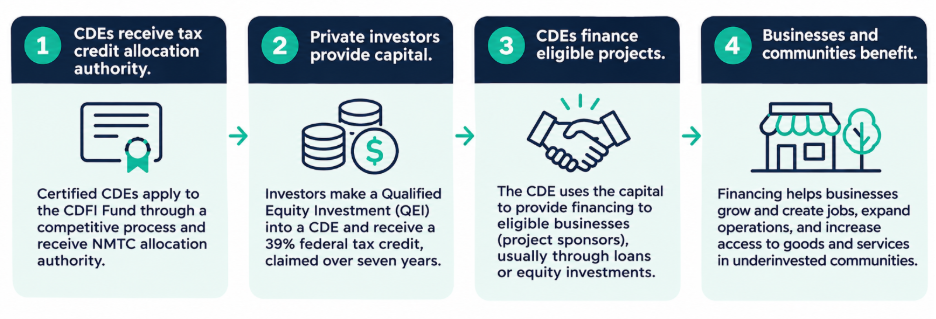
The federal program generally follows four steps:
- CDEs receive tax credit allocation authority. Certified CDEs apply to the CDFI Fund through a competitive process. Successful applicants receive authority to offer NMTCs to investors in exchange for qualifying investments.
- Private investors provide capital. An investor makes a Qualified Equity Investment (QEI) into a CDE and receives a federal income tax credit equal to 39% of that investment. The credit is claimed at 5% annually for the first three years and 6% annually for the remaining four years.
- CDEs finance eligible projects. The CDE uses the investment proceeds to provide Qualified Low-Income Community Investments (QLICIs), typically through loans or equity investments, to eligible businesses known as Qualified Active Low-Income Community Businesses (QALICBs), also referred to a project sponsors.
- Businesses and communities benefit. The financing funds qualifying costs such as facility construction, equipment purchases, business expansion, and other operational needs, which, in turn, support economic activity or increased access to goods and services in underinvested areas.
The tax credit goes to the investor, not directly to the project sponsor. However, the financial value created by the credit is passed along through more favorable financing terms.
Who Qualifies for New Markets Tax Credit Financing?
NMTC financing is available to certain for-profit businesses and community organizations operating in qualifying low-income communities.
Eligibility generally depends on two factors: the project’s location and the activities of the project sponsor receiving the financing.
Geographic Eligibility
At a minimum, a project generally must be located in a qualifying low-income census tract. Under federal NMTC rules, a census tract typically qualifies if it has:
- A poverty rate of at least 20%; or
- A median family income at or below 80% of the applicable area benchmark.
However, meeting these minimum requirements does not guarantee access to NMTC financing. Given the program’s competitive nature and limited allocation availability, CDEs often prioritize projects located in severely or deeply distressed census tracts, where the need for investment is greatest.
As a result, projects in areas experiencing higher levels of economic distress may be more competitive for NMTC financing. Special eligibility provisions may also apply in certain circumstances.
Eligible Businesses & Projects
Common types of NMTC-supported projects include manufacturing facilities, healthcare centers, schools and educational facilities, grocery stores, community facilities, and businesses seeking capital for expansion or equipment.
The business must also satisfy federal QALICB requirements concerning its operations, income, assets, and other qualifying activities.
Certain activities and property types are excluded. For example, residential rental property generally does not qualify, although eligible commercial components of mixed-use developments may be financed through appropriately structured transactions. Other examples of excluded businesses are hot tub parlors, massage parlors, suntan facilities, and commercial farming enterprises.
Meeting geographic requirements does not automatically guarantee eligibility or financing. Given the competitive nature of the NMTC program and limited availability of funding, project sponsors must also demonstrate that their operations, financing needs, and intended community benefits align with program requirements and CDE investment priorities. Projects that demonstrate strong potential for community impact may be better positioned to secure financing.
How Can NMTC Financing Reduce Project Costs?
One of the primary benefits of NMTC financing is its ability to help close funding gaps and reduce the cost of capital for eligible projects. Beyond favorable financing terms, including potentially lower interest rates and opportunities for loan forgiveness, NMTC financing also offers flexibility in how funds can be used. Capital can support a wide range of eligible expenses, including property acquisition, construction, renovations, equipment purchases and working capital. NMTC financing is designed to complement, not compete with, traditional bank lending. By working alongside conventional loans and other funding sources, it can help close financing gaps that traditional financing alone may not fully cover.
Most federal NMTC transactions use a leveraged financing structure, which combines private investor equity with debt financing.
Typically, an investment fund combines tax credit investor equity with a leverage loan. The combined funds flow into a CDE, which then provides financing to the qualified project through two loans:
A Loan: Generally represents the leveraged debt portion of the transaction and is expected to be repaid.
B Loan: Generally represents the tax credit equity contribution, net of certain transaction costs, and may be structured to provide a lasting financial benefit to the borrower.
During the seven-year compliance period, borrowers typically benefit from below-market interest rates, longer than usual interest-only payment periods, or other flexible financing terms.
Following that period, certain transaction structures allow the B Loan to be retired at a substantial discount, creating an effective subsidy that reduces the project’s long-term financing obligation.
Depending on the transaction, NMTC financing may provide an effective subsidy of approximately 15%–20% of project costs, according to our Tax Credit Consulting team.
Actual savings depend on the capital structure, investor pricing, transaction expenses, compliance requirements, and negotiated financing terms.
This can make a meaningful difference for projects where conventional financing alone is not enough to cover development or expansion costs.
Federal vs. State New Markets Tax Credits: What’s the Difference?
While federal and state New Markets Tax Credit programs share a common goal of encouraging private investment in underinvested communities, they operate under different authorities and may have different eligibility, financing, and application requirements.
Here’s how federal and state NMTC programs compare across key features, requirements, and benefits.
| Federal NMTC Program | State NMTC Programs |
| Administered nationally through the U.S. Treasury’s CDFI Fund. | Administered by designated state agencies under individual state laws. |
| Provides a 39% federal income tax credit over seven years. | Credit percentages, eligible state tax liabilities, and claim periods depend on state law. |
| Supports qualifying projects in eligible low-income communities nationwide. | Focuses on qualifying investments within the applicable state. |
| Awards allocation authority to CDEs through a federal competitive application process. | May have separate state application requirements, allocation limits, and schedules. |
How Do State NMTC Programs Work?
Several states have created NMTC programs modeled on the federal incentive, allowing investors to receive state-level tax benefits for financing qualifying businesses and community development projects.
For example, Wisconsin’s New Markets Development Act established a state CDE investment credit modeled after the federal program. The initiative supports qualifying businesses in low-income communities through private investment facilitated by CDEs.
State and federal NMTC programs can be layered together to increase the total tax credit subsidy available to eligible projects, helping close financing gaps and reduce project costs. Advantage Capital works with both federal and state programs to help businesses access financing opportunities that align with their needs. Each program has its own eligibility requirements, and combining incentives requires appropriate financial and legal structuring.
Interested in learning whether your state offers an NMTC program? Connect with our Investment team here to explore available programs and potential financing opportunities.
When Do NMTC Applications Open & How Are Allocations Awarded?
While the search for available NMTC Allocation can be highly competitive for project sponsors seeking to utilize NMTC financing, the process that CDEs go through to apply for that Allocation is equally competitive. Accordingly, understanding the application process is especially important for CDEs seeking allocation authority.
How do CDEs apply for Federal NMTC Allocation?
The CDFI Fund awards federal NMTC allocation authority through an annual application process.
Organizations seeking an allocation must be certified CDEs and satisfy the applicable certification application requirements for that round.
Applicants typically provide information about their organizational experience associated with investing in disadvantaged businesses and communities, investment strategy, proposed use of allocation authority, community development objectives, and capacity to deploy capital and manage compliance.
When Does the Application Process Happen?
The CDFI Fund establishes application periods for individual allocation rounds, and exact dates can vary.
CDEs should regularly review the CDFI Fund’s official NMTC application page for current application materials, deadlines, and requirements.
Successful applicants receive tax credit allocation authority, not a direct federal grant. They then work with investors and eligible borrowers to structure qualifying transactions.
How Do Project Sponsors Apply for NMTC Financing?
Community project sponsors and small business borrowers do not apply directly to the CDFI Fund for allocation authority.
Instead, they seek financing through CDEs that have available allocations or anticipate receiving them.
Project sponsors should be prepared to provide information about their proposed project, financing requirements, location, financial feasibility, development timeline, and anticipated community impact. The more impactful a project is, the more likely it is to receive NMTC financing, so detailed descriptions and quantified impacts are extremely helpful in the process.
Engaging with CDEs early can help sponsors determine whether their project meets eligibility requirements and whether NMTC financing aligns with their capital needs.
Do State NMTC Programs Follow the Same Application Schedule?
Not necessarily. State programs establish their own timelines and requirements.
Because federal and state deadlines can differ, advance planning is especially important for CDEs seeking allocations under multiple programs.
How Do NMTCs Bring Private Investment to Underinvested Communities?
The NMTC program is designed to address a persistent challenge: economically distressed communities often have businesses and development opportunities that struggle to attract enough private investment.
By providing tax incentives to investors, NMTCs encourage capital to flow toward projects that may otherwise face significant financing barriers.
According to the CDFI Fund, the federal NMTC program has generated approximately $8 in private investment for every $1 of federal funding since its inception, supporting job creation, business investment, and community development nationwide.
These investments can help manufacturers expand production, healthcare organizations increase capacity, and communities develop facilities that provide essential services.
For example, The Inspiration Center at Howell Park in Baton Rouge, Louisiana, demonstrates how NMTC financing can help bring community-focused projects to life. The 25,000-square-foot facility serves as a hub for youth and family programs, with Boys & Girls Clubs of Metro Louisiana as its anchor tenant and day-to-day operator.
NMTC financing played a key role in closing the project’s funding gap, helping make the development possible. The center provides programs and services that support youth development, strengthen families, and help address factors associated with community violence.
Watch the video below to hear how NMTC financing helped make The Inspiration Center possible.
Projects like The Inspiration Center illustrate how NMTC financing can help overcome funding barriers and support long-term investment in communities that have historically experienced limited access to capital.
Explore NMTCs & Tax Credit Consulting Services
NMTCs offer a proven way to connect private investment with businesses and community projects that may otherwise face barriers to flexible financing.
For project sponsors and small business borrowers, understanding eligibility and financing structures is an essential first step. For CDEs, developing a strong allocation strategy and managing program requirements can help translate tax credit authority into community development.
Advantage Capital’s Tax Credit Consulting team supports both sides of this process.
Our team works with community organizations and project sponsors seeking NMTC financing, as well as CDEs pursuing tax credit allocations. Our services include project finance assistance, application consulting, strategic planning, data collection and analysis, and regulatory reporting support.
Whether you’re developing a community facility, planning a business expansion, or preparing for an NMTC allocation round, our team can help evaluate available opportunities.
Connect with our Tax Credit Consulting team here to discuss your project needs.
FAQs: Federal New Markets Tax Credits
Do project sponsors receive the 39% tax credit directly?
No. The 39% federal credit goes to the qualifying investor. project sponsors benefit through financing provided by one or more CDEs, which may include below-market rates, flexible terms, or a reduction in long-term project financing costs.
Can NMTC financing be combined with other funding sources?
Yes. NMTC financing may be combined with other eligible sources, including traditional debt, grants, state incentives, and certain federal tax credit programs. Combining funding sources requires careful coordination of eligibility, transaction structures, and compliance requirements.
Is the federal NMTC program permanent?
Yes. Federal legislation enacted in 2025 made the program permanent, establishing $5 billion in annual allocation authority and allowing CDEs and investors to plan around its continued availability.
Advantage Capital Investment Adviser, LLC (“ACIA”), a wholly owned subsidiary of Advantage Capital Management Corporation (“Advantage Capital”), is an investment adviser registered under the Investment Advisers Act of 1940. Registration with the SEC does not imply a certain level of skill or training. Advantage Capital itself is not registered as an investment adviser with the SEC. Any advisory services described in documents directly or indirectly disseminated by Advantage Capital are provided exclusively by ACIA. The information contained herein is for informational purposes only and does not constitute investment advice, an offer, or a solicitation to buy or sell any security. Any offer to sell or solicitation of an offer to purchase any security or investment product will be made in compliance with applicable state and federal securities laws pursuant to a definitive confidential offering memorandum and/or similar documentation. Advantage Capital is an equal opportunity provider.
The individual case studies represent a small sample of investments that were selected to illustrate their community impact under state and federal tax credit programs. The profitability of any single investment was not a factor in the selection process. Nothing in this document should be interpreted or construed as performance data of any kind, nor as any implication or statement that investments previously made by Advantage Capital were or are successful, or that past performance is any indication of future performance. All investments involve risk and unless otherwise stated, are not guaranteed.